

Book an appointment
Unhurried appointments for people in a hurry.
Book online in under a minute, or message us and we will find the earliest slot.
Home / Stories / Root canal under a microscope
Stories · Root canal treatment
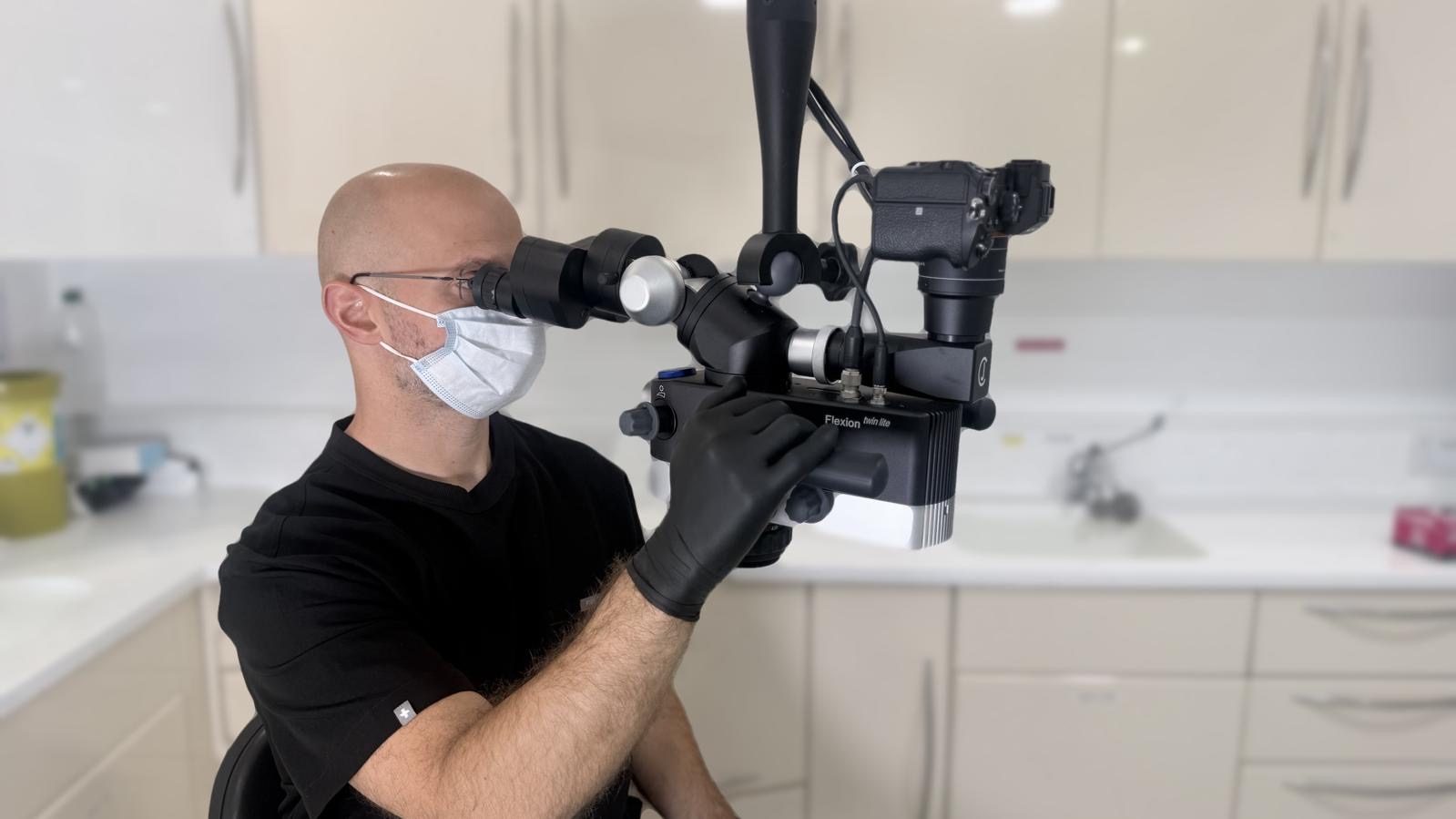
The canals inside a tooth can be narrower than a pin. An operating microscope lets me see and treat them directly, where the naked eye sees almost nothing. This is what that changes for you.
Most people arrive expecting the worst. Root canal treatment has a reputation it earned decades ago, with different equipment and different anaesthetics.
What surprises patients now is how uneventful it is. Much of that comes down to being able to see.
The inside of a tooth is not a single straight tube. Canals branch, curve and sometimes hide behind a ledge of dentine. Under the microscope, with a bright coaxial light, the floor of the tooth is magnified many times over.
A missed canal is a common reason a root-treated tooth flares up again later. Magnification makes extra canals much easier to find.
I can work through a smaller opening, which leaves more of the tooth to support the final restoration.
A crack running into the root changes the outlook for the tooth. It is better to know before treatment than after. More on how we find a cracked tooth.
Old root fillings, posts and blocked canals can often be worked around or removed when they can be seen.
A microscope does not guarantee an outcome. Some teeth have cracks or infection that make them a poor candidate, and I will say so at the consultation and explain the alternatives.
An examination, X-rays and a CBCT 3D scan where it helps. You leave with a written plan and fee.
The tooth is numbed with local anaesthetic and isolated with a rubber sheet. Most treatments take one or two visits.
Some tenderness for a few days is normal. The tooth then needs a permanent restoration, usually a crown, to protect it. Where suitable, that crown can be made and fitted in one visit.
Guide fees. You receive a written plan with exact fees before any treatment starts. See all fees.
Book a consultation, or call or WhatsApp 07497 573 936. You do not need a referral, and you can return to your own dentist for the crown.
Common questions
The tooth is numbed with local anaesthetic, so you should feel pressure but not pain during treatment. Tenderness afterwards usually settles within a few days.
Most teeth take one or two visits. Back teeth with several canals take longer than front teeth.
No. You can book directly, and return to your own dentist afterwards if you wish.
Keeping your own tooth is usually the first choice where its outlook is good. Where it is not, I will explain why and what the alternatives are.
Usually, for back teeth. A crown protects a root-treated tooth from fracture.
Book an appointment
Book online in under a minute, or message us and we will find the earliest slot.