
The process
From consultation to restored tooth
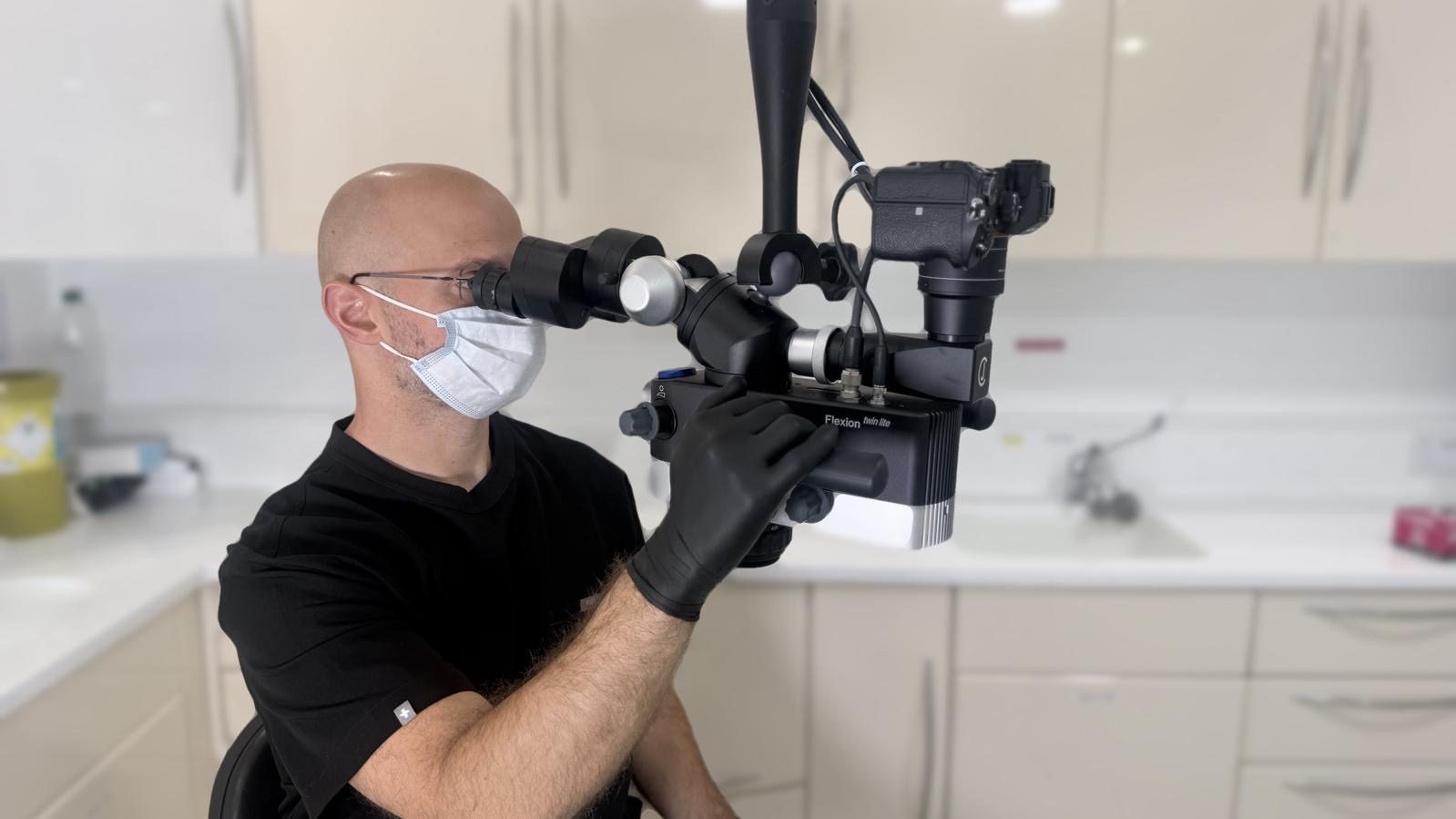
Dr Spencer Richman at the dental operating microscope.
Home / Treatments / Root canal treatment
Advanced dentistry · Microscope
Root canal treatment removes infected or inflamed pulp from inside a tooth, then cleans, shapes and seals the canals so the tooth can stay. Dr Spencer Richman, whose practice is limited to endodontics, carries it out under a dental operating microscope, with CBCT 3D imaging where needed. Most teeth take one or two visits. Consultation £150 including imaging; treatment from £1,200.
Guide fee
From £1,200
Consultation
£150, imaging included
Visits
Usually one or two
With
Dr Spencer Richman
Who it is for
A healthy tooth settles within seconds of a hot or cold drink. Pain that lingers for minutes afterwards suggests the pulp, the soft tissue inside the tooth, is inflamed and unlikely to recover on its own.
Spontaneous throbbing, or an ache that wakes you at night, usually means the pulp is badly inflamed or infected. It tends to worsen with time, so it is worth being seen promptly.
A tooth that is sore to bite on, a swelling in the gum beside it or a small spot that keeps reappearing can all point to infection at the tip of the root.
Some teeth lose their nerve quietly. The first sign may be a dark area on a routine X-ray or a tooth that has changed colour. We show you the image and explain what it means.
The difference
Dr Spencer Richman's practice is limited to endodontics. He holds an MSc in Endodontology and is a member of the British Endodontic Society. Root canal treatment and the diagnosis of cracked teeth are the whole of his clinical work.
More about Spencer's root canal work at spencerrichman.co.uk.
Root canals can be finer than a pin, and many teeth have more of them than expected. High magnification and bright, focused light let us find extra and narrow canals that are easily missed with the naked eye.
A standard X-ray flattens a tooth into two dimensions. Where the anatomy is complex, a CBCT scan taken on site shows the roots, canals and surrounding bone in 3D, so treatment is planned before it begins.
A rubber dam isolates the tooth, keeping saliva and bacteria out and the cleaning solutions in. Modern, flexible rotary instruments then shape each canal smoothly and efficiently, following its natural curve.
The process
Dr Spencer Richman at the dental operating microscope.
We examine the tooth, test how it responds and take the images needed, including a CBCT scan where it helps. You leave with a clear diagnosis, your options and a written fee. The consultation is £150.
The tooth is numbed with local anaesthetic and we wait until it is fully comfortable. A rubber dam is then placed around it. Most people compare the experience to having a filling.
Working under the microscope, we locate each canal, measure its length and clean it with fine rotary instruments and disinfecting solutions. This is the careful part, and it is given the time it needs.
The canals are filled and sealed to stop bacteria returning. Some teeth are completed in one visit. Others are dressed and finished at a second appointment, depending on the infection and the anatomy.
A root-filled tooth needs a sound restoration over the top to protect it. For back teeth that is often a crown, which can frequently be made and fitted in one visit with CEREC on site.
Afterwards
The tooth and the gum around it can feel tender for a few days, particularly on biting. This usually settles with ordinary painkillers, if they are suitable for you. Avoid chewing hard foods on the tooth until its final restoration is in place. Contact us if you notice swelling, or pain that is getting worse instead of easing.
Guide fees
Guide fees. You receive a written plan with exact costs before treatment starts. See all fees
Common questions
It is carried out under local anaesthetic, and most people compare it to having a filling. You should feel pressure and vibration, not pain. Some tenderness for a few days afterwards is normal and usually settles with ordinary painkillers.
Most teeth are completed in one or two visits. Back teeth with several canals, and teeth being re-treated, take longer than front teeth. We tell you how many appointments to expect at your consultation.
The consultation is £150 and includes imaging. Treatment is from £1,200, complex cases from £1,250 and surgical treatment from £1,300. You receive a written plan with the exact fee before anything starts.
Often, yes. A root-filled tooth can become reinfected if a canal was missed or the seal has broken down. Re-treatment means removing the old filling material, cleaning the canals again under the microscope and resealing them. We assess the tooth with imaging first and tell you plainly what its outlook is.
Canals are tiny, often curved and sometimes hidden. Magnification and bright light let us see inside the tooth in detail, find extra canals and check each one is clean before it is sealed.
Keeping your own tooth is usually preferable where it can be restored predictably. An extraction leaves a gap that may then need an implant, a bridge or a denture. Where a tooth has a poor outlook we will say so, and explain the alternatives.
Back teeth usually do. Root-filled molars and premolars are more prone to fracture, and a crown holds them together. Front teeth can often be restored with a filling instead.
Book an appointment
Book online in under a minute, or message us and we will find the earliest slot.